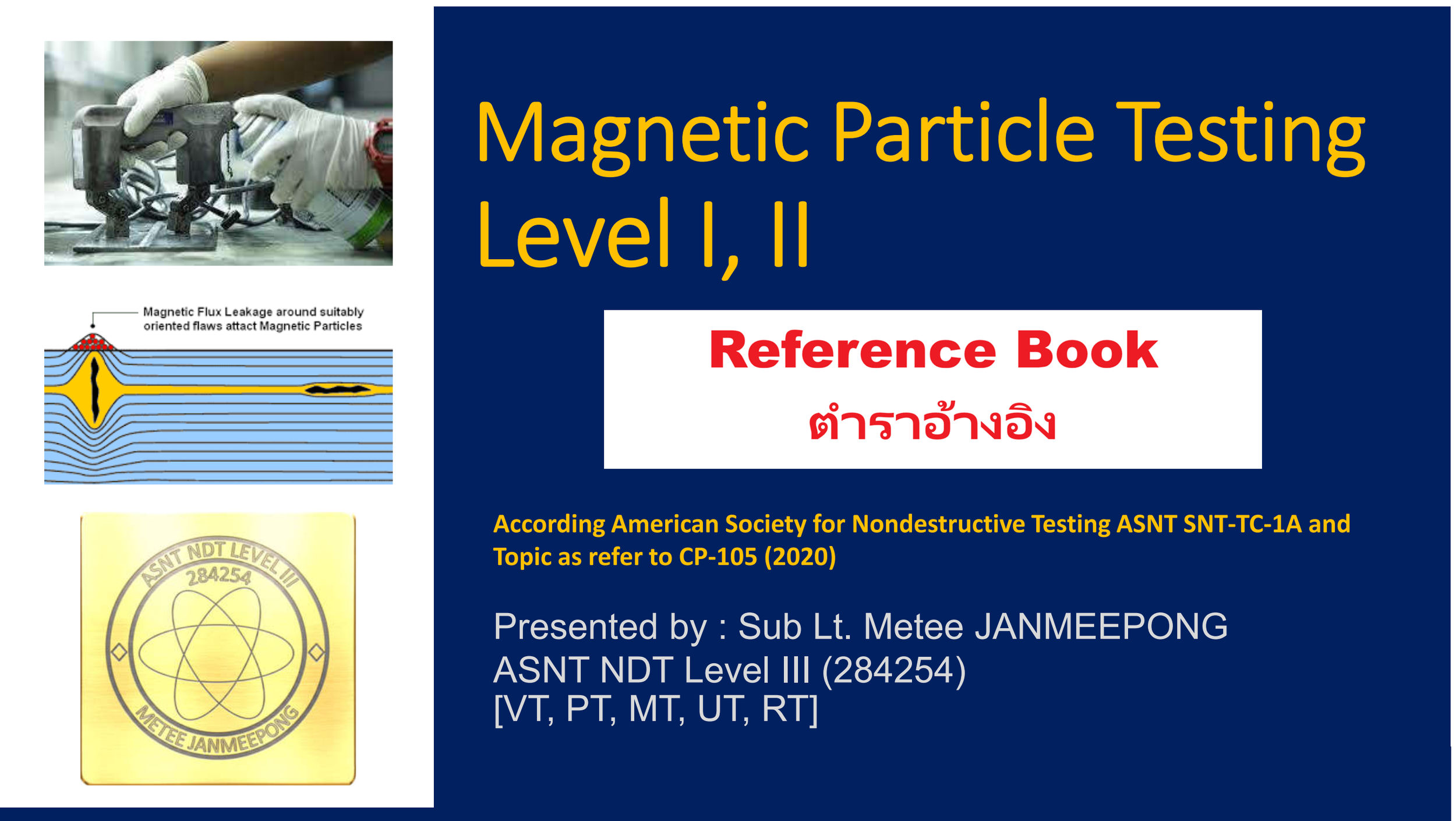
MT Level I-II (Online)
Thank you for your attention.
-
-
1.0 Principle of Magnets and Magnetic Fields
1.1 Theory of magnetic fields
1.2 Theory of magnetism
1.3 Terminology associatred with magnetic particle testing
1.1 Theory of magnetic fields
1.2 Theory of magnetism
1.3 Terminology associatred with magnetic particle testing
-
2.1 Bar magnet
2.2 Ring Magnet
-
3.1 Surface cracks
3.2 Scratches
3.3 Subsurface defects
-
4.0 Magnetization by Means of Electric Current
4.1 Circular field
-
4.0 Magnetization by Means of Electric Current
4.2 Longitudinal field
-
5.0 Selecting the Proper Method of Magnetization
5.1 Alloy, shape, and condition of part
5.2 Type of magnetizing current
5.3 Direction of magnetic field
5.4 Sequence of operations
5.5 Value of flux density
5.1 Alloy, shape, and condition of part
5.2 Type of magnetizing current
5.3 Direction of magnetic field
5.4 Sequence of operations
5.5 Value of flux density
-
6.1 Wet particle
6.2 Dry particle
-
7.0 Principle of Demagnetization
7.1 Residual magnetism
7.2 Reason doe requiring demagnetization
7.3 Longitudinal and circular residual fields
7.4 Basic principles of demagnetization
7.5 Retentivity and coercive force
7.6 Methods of demagnetization
7.1 Residual magnetism
7.2 Reason doe requiring demagnetization
7.3 Longitudinal and circular residual fields
7.4 Basic principles of demagnetization
7.5 Retentivity and coercive force
7.6 Methods of demagnetization
-
8.0 MT
8.1 Equipment selection considerations
-
8.0 MT
8.2 Manual inspection equipment
-
8.0 MT
8.3 Medium-and heavy-duty equipment
-
8.0 MT
8.4 Stationary equipment
-
8.5 Mechanized inspection equipment
8.0 MT
8.5 Mechanized inspection equipment
8.5.1 Semiautomatic inspection equipment
8.5.2 Single-purpose semiautomatic equipment
8.5.3 Multipurpose semiautomatic equipment
8.5.4 Fully automativ equipment
8.0 MT
8.5 Mechanized inspection equipment
8.5.1 Semiautomatic inspection equipment
8.5.2 Single-purpose semiautomatic equipment
8.5.3 Multipurpose semiautomatic equipment
8.5.4 Fully automativ equipment
-
9.0 Types of Discontinuites Detected by MT
9.1 Inclusions
9.2 Blowholes
9.3 Porosity
9.4 Flaskes
9.5 Cracks
9.6 Pipes
9.7 Laminations
9.8 Laps
9.9 Forging butsts
9.10 Void
9.1 Inclusions
9.2 Blowholes
9.3 Porosity
9.4 Flaskes
9.5 Cracks
9.6 Pipes
9.7 Laminations
9.8 Laps
9.9 Forging butsts
9.10 Void
-
10.0 Magnetic Particle Test Indications and Interpretations
10.1 Indications of nonmetallic inclusions
10.2 Indications of surface seams
10.3 Indications of Crack
10.4 Indications of Lamination
10.5 Indications of laps
10.6 Indications of bursts and flakes
10.7 Indication of porosity
10.8 Nonrelevant indications
10.1 Indications of nonmetallic inclusions
10.2 Indications of surface seams
10.3 Indications of Crack
10.4 Indications of Lamination
10.5 Indications of laps
10.6 Indications of bursts and flakes
10.7 Indication of porosity
10.8 Nonrelevant indications
-
-
-
1.0 Principle
1.1 Theory
1.1.1 Flux patterns
1.1.2 Frequency and voltage factors
1.1.3 Current calculations
1.1.4 Surface flux strength
1.1.5 Subsurface effects
1.2 Magnets and magnetism
1.2.1 Distance factors versus strength of flux
1.2.2 Internal and External flux patterns
1.2.3 Phenomenon action at the discontinuity
1.2.4 Heat effects on magnetism
1.2.5 Material hardness versus magnetic retention
1.1 Theory
1.1.1 Flux patterns
1.1.2 Frequency and voltage factors
1.1.3 Current calculations
1.1.4 Surface flux strength
1.1.5 Subsurface effects
1.2 Magnets and magnetism
1.2.1 Distance factors versus strength of flux
1.2.2 Internal and External flux patterns
1.2.3 Phenomenon action at the discontinuity
1.2.4 Heat effects on magnetism
1.2.5 Material hardness versus magnetic retention
-
2.0 Flux Fields
2.1 Direct current
2.1.1 Depth of penetration factors
2.1.2 Source of current
2.2 Direct pulsating current
2.2.1 Similarity to direct current
2.2.2 Advantages
2.2.3 Typical fields
2.3 Alternative current
2.3.1 Cycle effects
2.3.2 Surface strength characteristics
2.3.3 Saety precautions
2.3.4 Voltage and current factors
2.3.5 Source of current
2.1 Direct current
2.1.1 Depth of penetration factors
2.1.2 Source of current
2.2 Direct pulsating current
2.2.1 Similarity to direct current
2.2.2 Advantages
2.2.3 Typical fields
2.3 Alternative current
2.3.1 Cycle effects
2.3.2 Surface strength characteristics
2.3.3 Saety precautions
2.3.4 Voltage and current factors
2.3.5 Source of current
-
3.0 Effective of Discontinuities on Materials
3.1 Design factors
3.1.1 Mechanical properties
3.1.2 Part use
3.2 Relationship to load-carrying ability
3.1 Design factors
3.1.1 Mechanical properties
3.1.2 Part use
3.2 Relationship to load-carrying ability
-
4.1 Circular techniques
4.1 Circular techniques
4.1.1 Current calculations
4.1.2 Depth-factor considerations
4.1.3 Precountions – safety and overheating
4.1.4 Contact prods and yokes
4.1.4.1 Requirements for prods and yokes
4.1.4.2 Current-carying capabilities
4.1.5 Discontinuites commonly detected
4.1 Circular techniques
4.1.1 Current calculations
4.1.2 Depth-factor considerations
4.1.3 Precountions – safety and overheating
4.1.4 Contact prods and yokes
4.1.4.1 Requirements for prods and yokes
4.1.4.2 Current-carying capabilities
4.1.5 Discontinuites commonly detected
-
4.2 Longitudinal technique
4.2 Longitudinal technique
4.2.1 Principle of induced flux fields
4.2.2 Geometry of part to be inspected
4.2.3 Shapes and sizes coils
4.2.4 Use of coils and cables
4.2.4.1 Strength of field
4.2.4.2 Current deiriection flow versus flux field
4.2.4.3 Shapes, sizes, and current capacities
4.2.5 Current calculations
4.2.6 Discontinuites commonly detected
4.2 Longitudinal technique
4.2.1 Principle of induced flux fields
4.2.2 Geometry of part to be inspected
4.2.3 Shapes and sizes coils
4.2.4 Use of coils and cables
4.2.4.1 Strength of field
4.2.4.2 Current deiriection flow versus flux field
4.2.4.3 Shapes, sizes, and current capacities
4.2.5 Current calculations
4.2.6 Discontinuites commonly detected
-
5.0 Selecting the Proper Method of Magnetization
5.1 Alloy, shape, condition of part
5.2 Type of magnetizing current
5.3 Direction of magnetic field
5.4 Sequence of operations
5.5 Value of flux density
5.1 Alloy, shape, condition of part
5.2 Type of magnetizing current
5.3 Direction of magnetic field
5.4 Sequence of operations
5.5 Value of flux density
-
6.0 Demagnetization
6.1 Need for demagnetization of parts
6.2 Current, frequency, and field orientation
6.3 Heat factors and precautions
6.4 Need for collapsing flux fields
6.1 Need for demagnetization of parts
6.2 Current, frequency, and field orientation
6.3 Heat factors and precautions
6.4 Need for collapsing flux fields
-
7.1 Portable type
7.0 Equipment
7.1 Portable type
7.1.1 Reason for portable equipment
7.1.2 Capabilities of portable equipment
7.1.3 Similarity to stationary equipment
7.0 Equipment
7.1 Portable type
7.1.1 Reason for portable equipment
7.1.2 Capabilities of portable equipment
7.1.3 Similarity to stationary equipment
-
7.2 Stationary type
7.0 Equipment
7.2 Stationary type
7.2.1 Capability of handing large and heavy parts
7.2.2 Flexibility in use
7.2.3 Need for stationary equipment
7.2.4 Use of accessories and attachments
7.0 Equipment
7.2 Stationary type
7.2.1 Capability of handing large and heavy parts
7.2.2 Flexibility in use
7.2.3 Need for stationary equipment
7.2.4 Use of accessories and attachments
-
7.3 Automatic type
7.0 Equipment
7.3 Automatic type
7.3.1 Requirements for automation
7.3.2 Sequential operations
7.3.3 Control and operation factors
7.3.4 Alarm and rejection mechanisms
7.0 Equipment
7.3 Automatic type
7.3.1 Requirements for automation
7.3.2 Sequential operations
7.3.3 Control and operation factors
7.3.4 Alarm and rejection mechanisms
-
7.4 Multidirectional units
7.0 Equipment
7.4 Multidirectional units
7.4.1 Capability
7.4.2 Control and operation factors
7.4.3 Applications
7.0 Equipment
7.4 Multidirectional units
7.4.1 Capability
7.4.2 Control and operation factors
7.4.3 Applications
-
7.5 Liquids and powders
7.0 Equipment
7.5 Liquids and powders
7.5.1 Liquid requirements as a particle vehicle
7.5.2 Safety precautions
7.0 Equipment
7.5 Liquids and powders
7.5.1 Liquid requirements as a particle vehicle
7.5.2 Safety precautions
-
8.0 Types of Discontinuities
8.1 In casting
8.2 In ingots
8.3 In wrought sections and pats
8.4 In welds
8.1 In casting
8.2 In ingots
8.3 In wrought sections and pats
8.4 In welds
-
9.1 Use of standards- e.g. ASTM E1444, E3024, E709
9.0 Evaluations Techniques
9.1 Use of standards- e.g. ASTM E1444, E3024, E709
9.1.1 Need for standards and references
9.1.2 Comparison of known with unknown
9.1.3 Specifications and certifications
9.1.4 Comparison techniques
9.0 Evaluations Techniques
9.1 Use of standards- e.g. ASTM E1444, E3024, E709
9.1.1 Need for standards and references
9.1.2 Comparison of known with unknown
9.1.3 Specifications and certifications
9.1.4 Comparison techniques
-
9.2 Defect appraisal
9.0 Evaluations Techniques
9.2 Defect appraisal
9.2.1 History of part
9.2.2 Manufacturing process
9.2.3 Possible causes of defect
9.2.4 Use of part
9.2.5 Acceptance and rejection criteria
9.2.6 Use of tolerances
9.0 Evaluations Techniques
9.2 Defect appraisal
9.2.1 History of part
9.2.2 Manufacturing process
9.2.3 Possible causes of defect
9.2.4 Use of part
9.2.5 Acceptance and rejection criteria
9.2.6 Use of tolerances
-
10.0 Quality Control of Equipment and Processes
10.1 Malfunctioning of equipment
10.2 Proper magnetic particles and bath liquid
10.3 Bath concentration
10.3.1 Settling test
10.3.2 Other bath-strength tests
10.4 Tests for ultraviolet radiation intensity
10.1 Malfunctioning of equipment
10.2 Proper magnetic particles and bath liquid
10.3 Bath concentration
10.3.1 Settling test
10.3.2 Other bath-strength tests
10.4 Tests for ultraviolet radiation intensity
-
Create by Sub Lt. Metee JANMEEPONG
ASNT NDT Level III (284254)
[VT, PT, MT, UT, RT, ET]
MAKE IT STAND OUT
"This online Question and Answer platform is dedicated to sharing knowledge, guided by the principle of 'giving before receiving'."
(แพลตฟอร์มถาม-ตอบออนไลน์นี้อุทิศให้กับการแบ่งปันความรู้ โดยยึดหลักการ 'ให้ก่อนรับ')
"This resource may assist in the development of your NDT skills for future applications. It is currently available at no cost." (แหล่งข้อมูลนี้อาจช่วยในการพัฒนาทักษะ NDT ของคุณสำหรับการใช้งานในอนาคต ขณะนี้ยังไม่มีค่าใช้จ่าย)